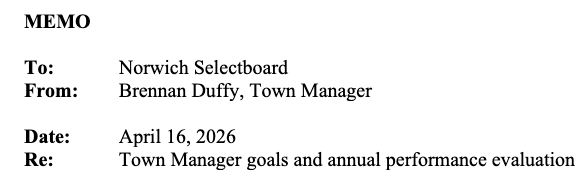
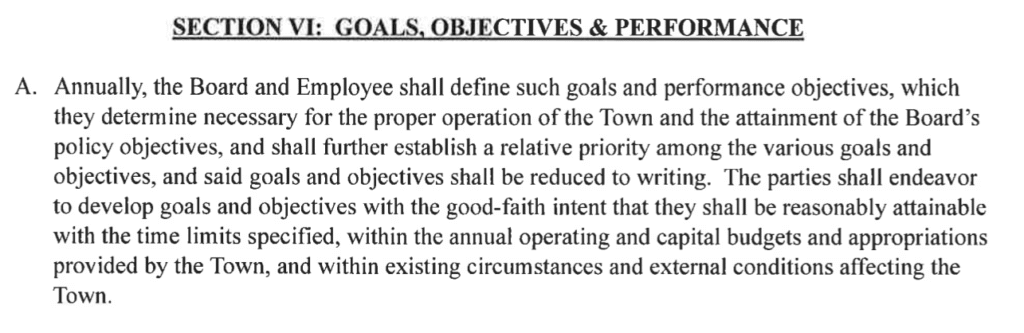
The Town Manager’s employment agreement requires the collaborative setting of written annual goals every September. That didn’t happen last year. At the April 8 meeting the Selectboard asked the Town Manager to submit his thoughts in writing. His memo is in the packet for Wednesday’s Selectboard meeting, beginning at page 34. Having read it, I have questions.
Delegating effectively is the Town Manager’s job. I don’t expect him to drive a plow truck or fix the Tracy Hall roof. If it is not getting done, that is on his watch, whether or not he climbed the ladder himself. Coordination across departments and contractors is real work. But the specific projects listed in the memo raise questions about where the Town Manager’s work ends and everyone else’s begins.
Where Are the Goals?
Over two and a half pages, the memo devotes only two bullet points to what the Town Manager actually intends to accomplish. The first is aspirational, the second is the more specific:
Prioritize several Special Projects related to actionable tasks with quantifiable outcomes. Special Projects in process during the 2026 evaluation period which seem realistically attainable before October 2026 include, TH roof repair initiative, TH elevator modernization initiative, TH energy efficiency planning, hazardous roadside Ash tree removal initiative, DPW facility improvement planning/study.
Missing Milestones
The memo offers no benchmarks or timelines. It mentions “quantifiable goals,” but does not identify a single quantifiable goal for any of these projects.
To illustrate what a more concrete approach might look like, here is a first cut of a simple project plan for a DPW facility study. It is not a finished product, but it demonstrates what a more specific plan would look like:
Target milestones: RFP for consultant by May 31, 2026; selection of consultant by July 31, 2026; conditions assessment completed by September 30, 2026; project priorities by November 30, 2026; cost estimates and implementation approach by January 31, 2027; draft report by March 15, 2027; final report by March 31, 2027. Timelines may be adjusted for factors outside the employee’s control.
A defined game plan was possible; the Town Manager’s memo simply did not provide one.
Delegated Work
When you look closely at who is actually doing the work, the Town Manager’s role in each specified project is thinner than the list suggests.
- Roof repair: A contractor has been hired for an approximately $4,000 project. The Town Manager’s own report in the packet indicates the work is due to be completed by the end of April, just seven days after Wednesday’s meeting.
- Elevator modernization: The elevator has broken down multiple times. The town’s service contractor is going to recommend upgrades. That is a service call escalating to a contractor recommendation.
- Energy efficiency planning: The Town pays upfront for access to a Shared Energy Coordinator through TROC. Energy efficiency is also part of the architect’s scope for the Tracy Hall modernization project.
- Ash tree removal: The Tree Warden and the EAB committee identified the trees and did public outreach. A contractor will remove the trees.
- DPW facility planning: The laboring oar belongs to the DPW Director, who would develop an RFP or RFQ for a consultant to produce a plan.
It is not clear from the memo how much of the Town Manager’s time is needed on each listed project.
Norwich has a full-time Assistant Town Manager, professional department heads, and a Shared Energy Coordinator. It is a wealthy town of roughly 3,600 residents with the fiscal resources to staff its government well. The Town Manager’s compensation is among the highest in the Upper Valley. We should expect better and more ambitious goal setting.
Selectboard Authority
The memo also proposes as a goal that the Selectboard support “the Town Manager’s autonomy to do the job in the way he best sees fit without attempting to control day-to-day functions.” I did not know this was a problem in Norwich.
Vermont law is clear on the relationship. Under 24 V.S.A. § 1233, the Town Manager “shall be subject to the direction and supervision” of the Selectboard “in all matters.” The Selectboard is not overreaching when it sets specific expectations for its Town Manager. That is its statutory job.
Wednesday’s meeting is an opportunity. The employment agreement requires written goals that are specific, prioritized, and reduced to writing. The Board should work with the Town Manager to establish goals meeting that standard — with real benchmarks, clear ownership, and public posting when adopted.
* * * *
Thanks for reading! Contact me at norwichobserver[at]gmail.com
It sounds reasonable to me Chris… as always.